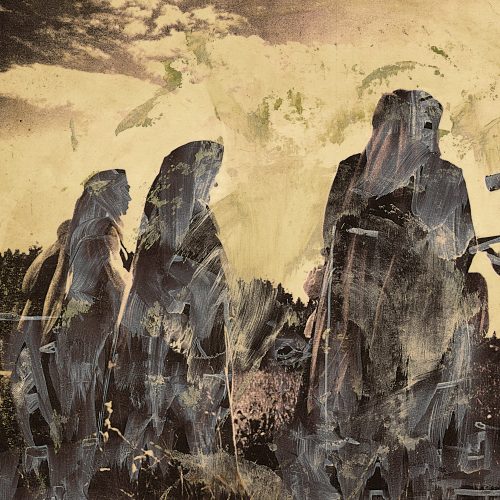
Mark Harwood follows up his 2022 offering with the new album, or, Urim.
or, Urim showcases a no holds barred approach to plunderphonics, resulting in a human head to hard drive battle of natural and synthetic emotion. or, Urim combines elements of psychedelia, progressive rock, progressive electronics, abstract electronics, avant classical and extreme electronics.
Harwood was born in 1972 and therefore resides in the rare pocket of humans that experienced both human and synthetic dominance within the span of their lives. There was and only will be a some of us.
or, Urim is a dusty digital futuristic head trip for generation then, now and next.
or, Urim is a record delighting in wholesale theft whilst occupying a meditation on the shifting tides of human and non-human dominance.
Utilising pre-existing musical forms for new forms is as old as DJ Kool Hercs. We live in an age where an 8 year old kid can be fined for recontextualising an 8 second long snippet of a soul song from 68, whilst certain ketamine fueled companies can scrape the entire history of culture for capital gain.
Harwood teases a hearing aid to the new ear of hope, fear, doubt, dread and dreams de jour.
Reviews etc
“An encounter with Mark Harwood’s auditory world is something truly special.It’s inhabited by paranormally active poltergeists.Some of them even seem to live inside television sets.You surely remember.It’s a strange, ghostly collage of songs, field recordings, and all sorts of unnameable found objects.Mark Harwood’s world is definitely odd.It’s like walking through an unfamiliar house where a different world opens behind every door.You never know which door to open.It’s somehow magical and unique”. – radiohoerer
Haha I get it. Yep, quick, tell Mark Harwood I’ve cracked the code. It’s funny right? Some albums are puzzles that on immediate listen seem to make no sense, it’s like there’s something greater at play, a deep conceptual plan, a series of in jokes that only the chosen shall understand. In this sense whether the music gives you pleasure, creates endorphin rushes or reminds you of your first kiss becomes kind’ve redundant, as does whether there’s a killer guitar solo on the 3rd track, or the vocals of a Vietnamese llama on track 9.
Everything is in slave to the concept. And in this case that concept is theft. A notion that is as old as the art itself. It used to be race based, with Elvis and The Rolling Stones getting rich stealing from black people, but more recently its based on $. Rich people get to steal our art and thoughts with impunity; poor people get sued and bankrupted.
It feels bold in this litigious world to make a plunderphonics LP, but Mark Harwood is a bold man. The music industry is specifically designed for exploitation, so maybe its time for artists to take their own back. Or go out in a blaze of glory.
I have to be honest, I’m not much of a trainspotter, so the source material isn’t immediately obvious, but between his musique concrete sensibilities, and layering of children’s voices over wigged out Eastern European progressive rock its pretty fun. Of course much of it feels like its coming in from the next room with someone rubbing a contact mic on their genitals in the foreground, but that’s part of the experience. Harwood, has run labels for decades, most recently Penultimate Press, though he was also the head honcho of cult Melbourne weirdo record store Synaesthesia for many years. It’s safe to say his knowledge of eclectic musics is unparalleled. So I never stood a chance. Not that it’s a competition.
So the question is what does it mean? A fuck you to the music industry by collaging music and manipulating stuff we’ve never heard before? That doesn’t really make sense.
So I asked AI. It says that “or, Urim” refers to sacred lots used by the Israelite High Priest for divine guidance and revealing God’s will, though also for deciding guilt and military actions. Thankfully it also refers to Harwood, I suppose I should’ve gotten it to crack the code instead of trying to use my own brain. This is what it says: “Style: Experimental, plunderphonics, combining natural and synthetic sounds for a futuristic feel.“
If this is the future I am scared. I suppose that’s the point. WAKE THE FUCK UP!
“It’s something of a tonic to move on to a record fuelled by an implicit hatred of ‘the music industry’, technological progress (or the spectrum of crimes committed in its name) and accomplished professionalism. Well, maybe not that last one – there’s plenty of it to be heard on or, Urim, Mark Harwood’s latest solo LP. It is though performed by people who Harwood, who runs the Penultimate Press label from his London home, has likely not met and who are equally likely unaware they feature on this zonged-out field-hospital stitch-up: five hairy tracks of plundered groove and general copyright liberation fronting.
In the tarnished tradition of these sorts of risk-it-all releases, it’s hard to say for certain what we hear Harwood doing here, though it’s not nowt: ‘Tarshish’ is peppered by the sort of crinkled pocket-dial noise you might expect from someone like Posset. The unspoken musical theme of or, Urimis mellotron-mad mid-70s German prog, multiple doorstop-thick slices of which emerge near-intact from the mist: I won’t name names in case surviving band members have Google Alerts set up and are litigious, both of which feel likely. Arguably as much a mixtape as an artist album, if you’re on Mark Harwood’s level you should initially enjoy having your lines blurred, and then enjoy realising you don’t have to care”. – The Quietus
enultimate Press figurehead Mark Harwood plunders the gen X memorybanks on his followup to 2022’s ‘Offering’, considering the legacy of sampling and the algorithmically-accelerated death of culture with a suite of lysergic collages that sound as if Graham Lambkin’s been let loose on the Ohr archive.
Harwood’s old enough to remember a time before “synthetic dominance”, indeed, when he was born in 1972, the Minimoog Model D – the first properly portable, commercially successful synthesizer – had only been around for a couple of years. He’s watched electronic technology warp every aspect of his life so is unsurprisingly vinegary about the regressive restrictions placed on modern artists. “We live in an age where an 8 year old kid can be fined for recontextualising an 8 second long snippet of a soul song from 68,” he explains. “Whilst certain ketamine fueled companies can scrape the entire history of culture for capital gain.” He’s not wrong. Forty-six years after the Fairlight CMI hit the shelves, sampling is now more difficult than ever; you either pay an exorbitant price for the privilege, or operate so far from the spotlight that nobody cares.
‘or, Urim’ throws caution to the wind in the same year that Spotify took control of notorious snitch database WhoSampled, gluing together tracks from Harwood’s vast collection to form a hypnagogic statement that neatly skewers contemporary tastes. Keen Penultimate Press followers will certainly tune into some familiar sounds, but it’s the way Harwood fashions a narrative that has us reeling. He’s clearly aware of the burn’d and churn’d reissue industry and its seemingly inexhaustible obsession with Deutsche psychedelia and “lost” Eastern European art sleaze. These elements – decayed riffs, campy organ vamps – are powdered and sprinkled over a soup of obnoxiously uglified electronic coughs and burps and foley blunders that fully prevent the music from slipping into the background.
Harwood’s statement seems to poke fun at the Organ Industrial Complex, the recent avant fascination with sacred music and the very concept of ambiance vs. ambient. Singing bowl drones are muddled with janky breaks and ethereal chants, ruptured by alien interference and Leslie-twirled Hammond bursts and nostalgic themes are smudged with Radiophonic blips, half-heard dialog snippets and acidic folk loops. ‘or, Urim’ is a record that’s far easier to digest than sounds on paper, but give it time and Harwood’s vision inevitably flickers through like an overplayed VHS on a burned-out CRT display.
“Fragments of psychedelia, progressive rock, noisy detonations, vocal performance, electronics and elements of avant-garde and new music create a feverish mosaic that at the same time reflects on the past and anticipates the future and is bursting with abundance: Some others would have made an entire album from a masterpiece like the longer piece “Tarnish”. “or, Urim”, whose title is probably borrowed from Hebrew and refers to light or an angel of light, is a meditation on the relationship between appropriation, loss and technical reproduction and at the same time a sarcastic comment at a time when cultural appropriation is criminalized, but algorithmic skimming is celebrated as innovation. The LP will be released in an edition of 300 copies, the album is also available for download. It will be released after his debut of his band El Jardín De Las Matemáticas last year and the tape “10 Scenes & 1 Dream” (Total Black), at the same time he will release the CD “Two Actors” (Akti Records)”. – African Paper
Mark Harwood’s “or, Urim” is one of those records that doesn’t knock politely. It kicks the door, apologises halfway through, then steals your coat on the way out – and somehow you thank it for the experience. Released on his own Penultimate Press, the album continues Harwood’s long-standing obsession with fractured authorship, cultural debris, and the uneasy romance between human memory and machine logic.
Harwood, born in the early ’70s, belongs to that awkward in-between generation: old enough to remember when sound was scarce, physical, and stubbornly slow; young enough to witness its collapse into infinite, frictionless data. “or, Urim” lives exactly in that crack. It’s plunderphonic in spirit but not nostalgic, gleefully irresponsible yet oddly reflective – like rifling through an abandoned archive while wondering who will own the ruins.
Musically, the album behaves like a hallucination with a filing system. Psychedelia rubs shoulders with progressive electronics, avant-classical gestures appear and vanish, and extreme digital abrasion keeps reminding you that comfort is not on the menu. Harwood doesn’t collage for shock value alone; he rearranges pre-existing forms until they start asking uncomfortable questions about authorship, ownership, and power. This is less “sampling culture” and more “sampling as civil disobedience”.
Tracks stretch and compress time in unpredictable ways. “Tarshish” unfolds like a slow, ceremonial data breach, while “Treuer Atem” breathes with an uncanny, half-organic pulse – intimate, then suddenly alien. On the flip side, “The Hunt (Pathetic Study)” feels deliberately awkward, as if testing how much absurdity a structure can tolerate before collapsing. And the closing “Hesychasm or Urim and Thummim” is a long, murmuring descent: part ritual, part corrupted firmware update, hovering between meditation and menace.
There’s humour here, but it’s dry, sideways, and occasionally cruel – the kind that laughs not because things are funny, but because the alternative is screaming. Harwood seems acutely aware of the irony of living in an era where a child can be punished for recontextualising a few seconds of sound, while vast systems ingest entire cultural histories without blinking. “or, Urim” doesn’t resolve this contradiction; it sharpens it, presses it to the ear, and listens for feedback.
In the end, this is not a comforting record, nor does it pretend to be. It’s dusty and futuristic at once, a head trip that acknowledges both the thrill and the dread of our synthetic present. “or, Urim” delights in theft, yes – but also in the fragile hope that meaning can still leak through the cracks. A record for those who enjoy their electronics unstable, their philosophy unresolved, and their questions left deliciously unanswered.